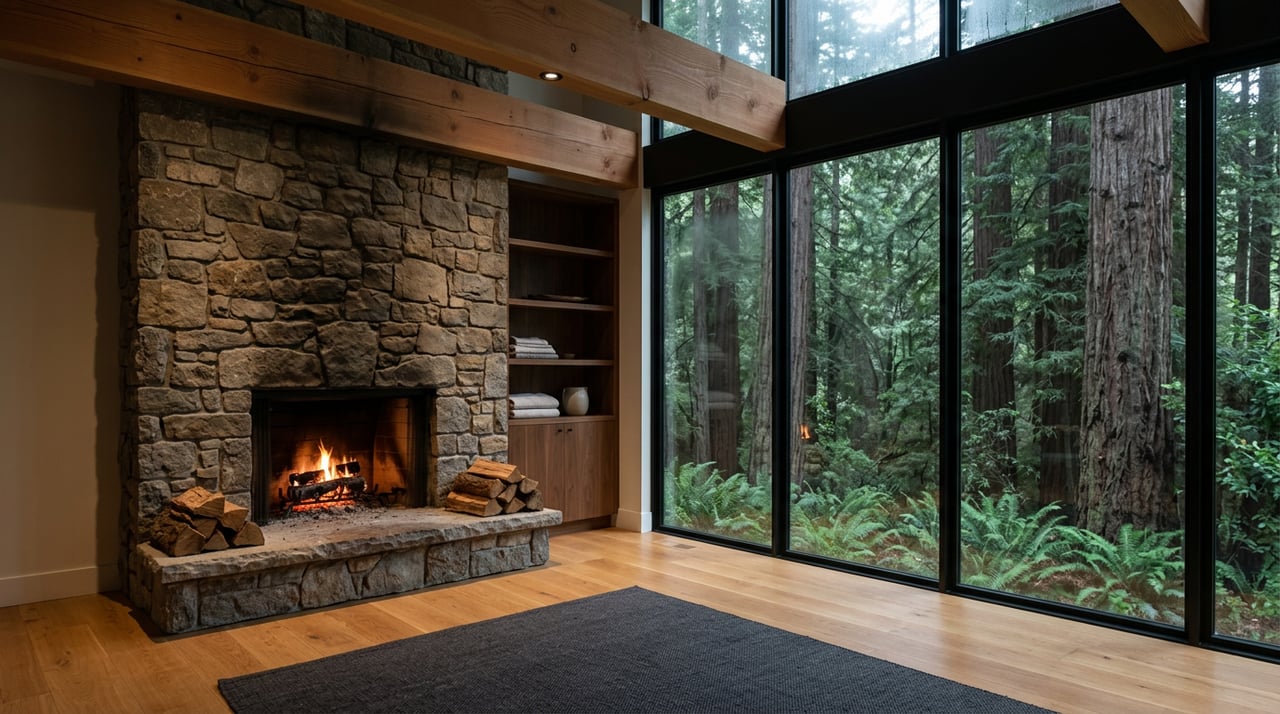
Two houses go on the market on Braemoor Drive this month, a street where only a handful of the original homes were left standing after the CZU Lightning Complex Fire. One is among the survivors, a farmhouse with a septic tank that has been in the ground since the Reagan administration. The other burned to the foundation in August 2020 and was rebuilt in 2023 with a permitted, engineered system designed to today's standards. Ask any agent which one should close faster, and most will guess the older, more established property. In Bonny Doon right now, they would be wrong.
The reason has nothing to do with charm, condition, or price. It has to do with a single exemption buried in Santa Cruz County's septic ordinance, and it is the kind of detail that only shows up once you are deep enough into an offer to feel its consequences.
The Rule That Surfaces Mid-Escrow
Since July 1, 2023, Santa Cruz County has required a point-of-sale septic inspection for any property served by an onsite wastewater treatment system, under County Code Section 7.38.216. The seller has to get the tank pumped and inspected, and the report has to accompany the disclosure package. For years the report had to be dated within six months of closing. In 2025, the county's OWTS Disclosure Advisory extended that window to 12 months, giving sellers more breathing room to schedule an inspection before their home hits the market.
But the ordinance also carries an exemption that rarely gets mentioned outside the fine print: a property is exempt from the point-of-sale inspection entirely if its OWTS was installed under permit within the last five years. That single clause is what separates the two houses on Braemoor Drive.
Why the CZU Rebuilds Are the Easy Closings
Homes that burned in 2020 and were rebuilt with new, permitted septic systems in 2021, 2022, or 2023 are still sitting inside that five-year exemption window as of today. Their sellers skip an inspection step that can otherwise take weeks to schedule with a limited pool of county-approved liquid waste haulers. Meanwhile, a Bonny Doon property that quietly survived the fire, on Bonny Doon Road, Empire Grade, or the Braemoor Drive area where entire blocks were lost, is now subject to the full inspection and disclosure process precisely because its system is old enough to need one.
The math behind this is worth sitting with. Five years after the fire, Santa Cruz County's rebuilding data shows only about 160 of the 911 homes destroyed in the CZU fire have been reconstructed, a figure confirmed by the county's own CZU Fire Recovery Permit Center Dashboard, which as of last year showed 155 single-family homes rebuilt with permits still outstanding on another 142. That is a small population of homes, but it is a population that happens to clear the county's newest disclosure hurdle without lifting a finger, simply because the fire forced their systems to be replaced on the county's own timeline.
This will not last. The earliest rebuilds, the ones permitted in 2021, are approaching their fifth anniversary this year, and each one that crosses it rejoins the pool of properties that need a fresh inspection before sale. The advantage is real, but it has an expiration date, and buyers touring listings this fall should ask exactly when a rebuilt home's septic permit was finalized, not just whether the house is new.
Two Disclosure Clocks Running at Different Speeds
The septic rule is not the only clock a Bonny Doon transaction has to answer to anymore. Starting September 1, 2025, under County Code Section 7.73.075, every transfer of rural real estate served by a private well or Individual Water System now requires testing for both water yield and water quality before closing. The rule has now been in force for almost a year, which means every Bonny Doon transaction moving through escrow today, whether it started last month or closes next week, falls under both disclosure regimes at once.
| Requirement | In effect since | Report validity | Exemption |
|---|---|---|---|
| Septic (OWTS) point-of-sale inspection | July 1, 2023 | 12 months (extended from 6 in 2025) | New system permitted within 5 years |
| Well/IWS water quality and yield test | September 1, 2025 | Not yet established countywide | None currently published |
That gap in the right-hand column matters. Where a rebuilt home can sidestep the septic inspection, there is no comparable carve-out yet for the well test. A buyer looking at two rebuilt homes on the same street, both exempt from septic inspection, can still find one seller scrambling to schedule a well yield test that the other already completed. The paperwork readiness of a Bonny Doon listing today depends on which of these two rules its history happens to satisfy, and that is not something a listing photo or a square footage number will tell you.
What This Actually Costs
None of this is bureaucratic trivia. Santa Cruz County's own Environmental Health Division notes that failure of either an OWTS or an Individual Water System can cost up to $100,000 to replace, a number that reframes what a buyer is actually underwriting when they waive a septic or well contingency to compete for a Bonny Doon property. Wells south of Valencia Creek carry an added requirement, testing for hexavalent chromium, a known carcinogen tied to the region's groundwater geology, which adds another line item and another lab turnaround to the closing timeline.
Local septic contractors who work the mountain routinely describe a different job than the one they run in Felton or Santa Cruz proper: locked gates, gravel driveways longer than some commutes, and engineered systems required wherever gravity layouts will not work on steep terrain. That is not a complaint about the area. It is a fact about what an inspection actually involves once you are past the incorporated city limits, and it is why scheduling one during a 30-day escrow can be the tightest part of the whole transaction.
What Buyers and Sellers Should Actually Do
If you are selling a Bonny Doon property, find out today whether your septic system was permitted within the last five years. If it was, gather that permit paperwork now, because it is your exemption and your fastest path through disclosure. If it was not, book your pumping and inspection before you list, using the full 12-month validity window to your advantage rather than scrambling once you are in contract.
If you are buying, ask two specific questions before you write an offer: when was the septic system permitted, and has the well been tested under the new rule that took effect this September. A rebuilt home's speed advantage is real but temporary, and a well test that has not been scheduled yet can add weeks you did not budget for in a competitive offer.
A Few Questions Worth Asking Directly
Does every home in Bonny Doon have both a well and a septic system? Most do, since the area sits outside any municipal water or sewer service, but a buyer should never assume this. Confirm both systems and their permit history before removing contingencies.
What happens if a rebuilt home's exemption window has already closed? The property simply returns to the standard rule: a septic inspection dated within the last 12 months, arranged by the seller, before the sale can close.
Is this different from buying in an incorporated city like Scotts Valley or Capitola? The septic and well disclosure rules apply countywide, including incorporated cities, but properties on public water and sewer are exempt entirely. Bonny Doon's rural, unincorporated character is what makes both rules relevant on nearly every listing.
The county did not design these ordinances around the CZU fire, but the fire is what created the exemption's most visible test case. A property that lost everything five years ago may now be the one that closes without friction, while its neighbor that survived is the one working through paperwork. That is not a reason to avoid a Bonny Doon purchase. It is a reason to ask sharper questions before you write an offer, and to work with someone who already knows which questions those are.
If you are weighing a purchase or a sale in Bonny Doon and want a clear read on where a specific property stands on both of these clocks, Genie Lawless has spent two decades working Santa Cruz County's neighborhoods, including the ones without a fire hydrant on the corner. Get Your Home Valuation and start the conversation with someone who already knows what to ask.