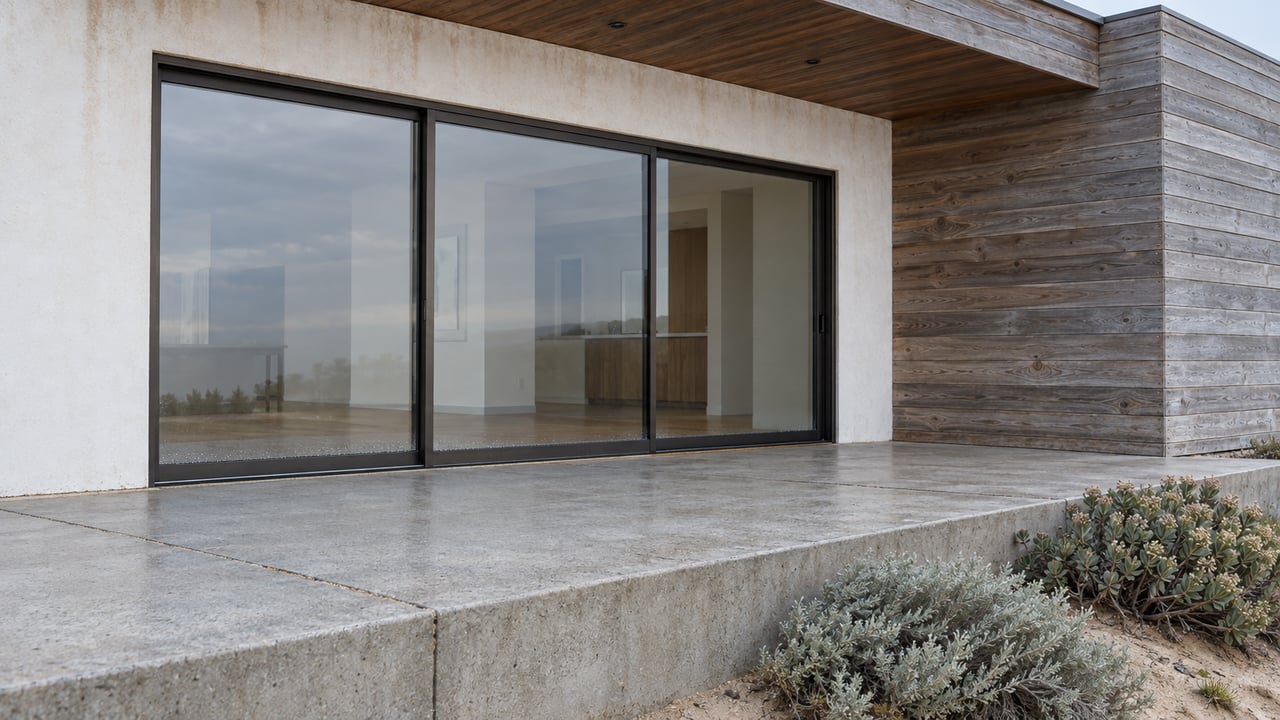
Beach Drive runs along the bluff in Rio Del Mar, and the county's zoning files on that street show a pattern fast. House after house needed a Coastal Development Permit, a variance, a soils report, and a geologic review before anyone could touch a foundation. Two homes can sit almost next door to each other, look about the same age, and still face completely different renovation rules the moment an owner wants to add a bedroom or replace a deck. The difference rarely has anything to do with what the home sold for. It comes down to a much narrower question: whether that specific parcel's original coastal permit is actually sitting in a county file.
That question matters more in Aptos than in most Santa Cruz County towns, because so much of Rio Del Mar, Seacliff, and Seascape sits inside the California Coastal Zone, where a permit history follows the parcel, not the price tag.
The Coastal Zone Covers More of Aptos Than Most Buyers Assume
The California Coastal Act of 1976 created a Coastal Zone that runs along the entire state shoreline, and in Santa Cruz County it extends roughly five miles inland from the North Coast. It narrows closer to town, shrinking to about 0.6 miles between Natural Bridges and 41st Avenue in Capitola, then widening again to run all the way to Highway 1 from Capitola south through Aptos, according to the county's own Coastal Development Permit guidance. In practice that means most of Rio Del Mar, Seacliff, and Seascape sits inside the Coastal Zone, not just the homes with sand in the backyard. A property inland from the beach, closer to the freeway than the water, can still fall under coastal review depending on exactly where the zone boundary lands.
Inside that zone, the county's default is that any construction, reconstruction, size change, demolition, or significant grading counts as development, and development needs a Coastal Development Permit unless it fits a specific exemption in the county code.
Being Exempt Still Has Exceptions
The county code does carve out smaller projects. Additions and accessory structures under a certain size, replacement of wells and septic systems, and landscaping outside the blufftop and beach areas can often skip the full permit process.
That exemption disappears fast once a few conditions are met. A project can lose its exempt status if it sits on a beach or wetland, falls within 50 feet of a coastal bluff, involves more than 100 cubic yards of grading, or sits on a steep slope, per the county's guidance. Separately, anything located within 300 feet of a beach, high tide line, or coastal bluff top, or within 100 feet of a stream, estuary, or wetland, lands in what the county calls Appeal Jurisdiction, meaning even an approved permit can be appealed up to the California Coastal Commission.
Here's roughly how that plays out for a typical Aptos beach-area remodel:
| Project detail | Usually skips a full CDP | Usually triggers one |
|---|---|---|
| Small addition, standard lot | Often exempt | Not unless near a bluff |
| Any work within 50 feet of a coastal bluff | Rarely exempt | Yes, regardless of size |
| Grading over 100 cubic yards | Rarely exempt | Yes |
| Replacement well or septic system | Often exempt | Not typically |
| New structure on a beach or wetland | Not exempt | Yes |
None of this is about whether a house is well kept or the neighborhood is desirable. It is entirely about where the parcel's lines fall relative to the mapped bluff edge and the beach.
The Rebuild Exemption Has a Catch Most Owners Never Hear About
Santa Cruz County allows a "replacement after disaster" exemption under county code section 13.20.063, which lets many owners rebuild a home that burned or was otherwise destroyed without going through a brand new Coastal Development Permit. On paper, that sounds like a fast path back to a finished house.
The county's own Coastal Zone FAQ adds a condition that catches people off guard: a home that never had a coastal permit when it was originally built does not qualify for that rebuild exemption, and the owner has to go through a first time Coastal Permit instead. Plenty of homes along the Aptos coastline predate organized coastal permitting entirely, built before the 1976 Coastal Act existed or before the county's Local Coastal Program was certified. If one of those homes is ever lost to fire or storm damage, the owner isn't rebuilding under a streamlined exemption. They're starting from a first time CDP review, with the timeline and cost that implies.
The lesson for a buyer isn't about the age of the structure. It's about whether a permit exists for it in the county's records, and that's a fact you can only get by asking the county directly, not by looking at the listing.
ADUs Ran Into the Same Wall
Senate Bill 1077 was written to make accessory dwelling units easier to build statewide by exempting many of them from needing a Coastal Development Permit. Andrew Talmadge, president of Aptos-based Talmadge Construction, put the limits of that exemption plainly in a company blog post on the new law: homes located in blufftops, erosion zones, flood-prone areas, or sites of ecological or historical significance stay subject to traditional CDP review, and in Santa Cruz County those areas are more common than many homeowners realize.
For anyone thinking about an ADU as a rental income strategy on an Aptos coastal lot, that distinction is worth confirming before budgeting a project timeline around the simplified statewide process. A parcel close enough to a mapped bluff edge can lose the SB 1077 shortcut entirely and land back in the same CDP process as any other coastal remodel.
The Rulebook Is Being Rewritten Right Now
None of this is static. Santa Cruz County is in the middle of a Sea Level Rise Vulnerability Assessment Project, described on the county's planning site as a community driven effort to identify coastal hazard risks and adaptation strategies that will feed into an update of the county's Local Coastal Program. The working groups organizing that process have explicitly grouped Pot Belly Beach, Aptos, Beach Drive, and Seacliff together as one of the areas under review for adaptation strategy and policy triggers.
That process is active, not theoretical. The county hosted a public Community Workshop at the Live Oak Community Center on March 26, 2026 to gather input on draft adaptation strategies and policy direction, according to a notice posted by the Coastal Property Owners Association, a group that has been formally submitting questions to the county's consulting team following working group sessions held through the fall of 2025. Whatever policy comes out of that process will govern what future Coastal Development Permits allow on these same blocks. A rule that applies to a Rio Del Mar remodel today could shift by the time a multi-year renovation or rebuild actually gets underway.
What to Ask Before You Write an Offer or Pull a Permit
A few questions are worth asking directly, whether you're buying, selling, or planning work on a property you already own in Aptos's coastal neighborhoods:
- Does the county have a Coastal Development Permit on file for the structure as it exists today, including any past additions?
- How far is the structure from the mapped bluff edge, and has a geotechnical survey ever measured that distance for this specific parcel?
- If the home were destroyed, would it qualify for the disaster-rebuild exemption, or would it require first-time CDP review?
- If an ADU is part of the plan, does the parcel actually qualify for the SB 1077 exemption, or does its location put it back under full CDP review?
- Is the property inside one of the areas the county's Sea Level Rise Vulnerability Assessment Project is currently reviewing for future adaptation policy?
None of these questions show up on a listing sheet. They come from the county's permit history and planning files, and they're the kind of detail that turns a straightforward remodel into a months-long process, or the reverse.
A Few Quick Questions
Does every home in Aptos need a Coastal Development Permit for renovations? No. Many smaller projects on parcels outside the Appeal Jurisdiction and away from bluffs and beaches qualify for an exemption. The exemption narrows fast once a project sits within 50 feet of a coastal bluff or involves significant grading.
Can I check whether a specific Aptos property already has a Coastal Development Permit on file? Yes. The county's planning division keeps permit records that can be searched for a given parcel, and that history is worth requesting before finalizing plans for a remodel, rebuild, or ADU.
Will the county's Sea Level Rise planning process change permits that are already approved? The current process is focused on shaping future adaptation strategy and policy direction for the Local Coastal Program update. The community workshops through 2025 and into 2026 are still gathering input rather than finalizing new rules.
If you're weighing a purchase in Rio Del Mar, Seacliff, or Seascape, or you already own a piece of the Aptos coastline and are thinking about what comes next for it, Genie Lawless can help you pull the permit history on a specific parcel before it becomes a surprise mid-project.