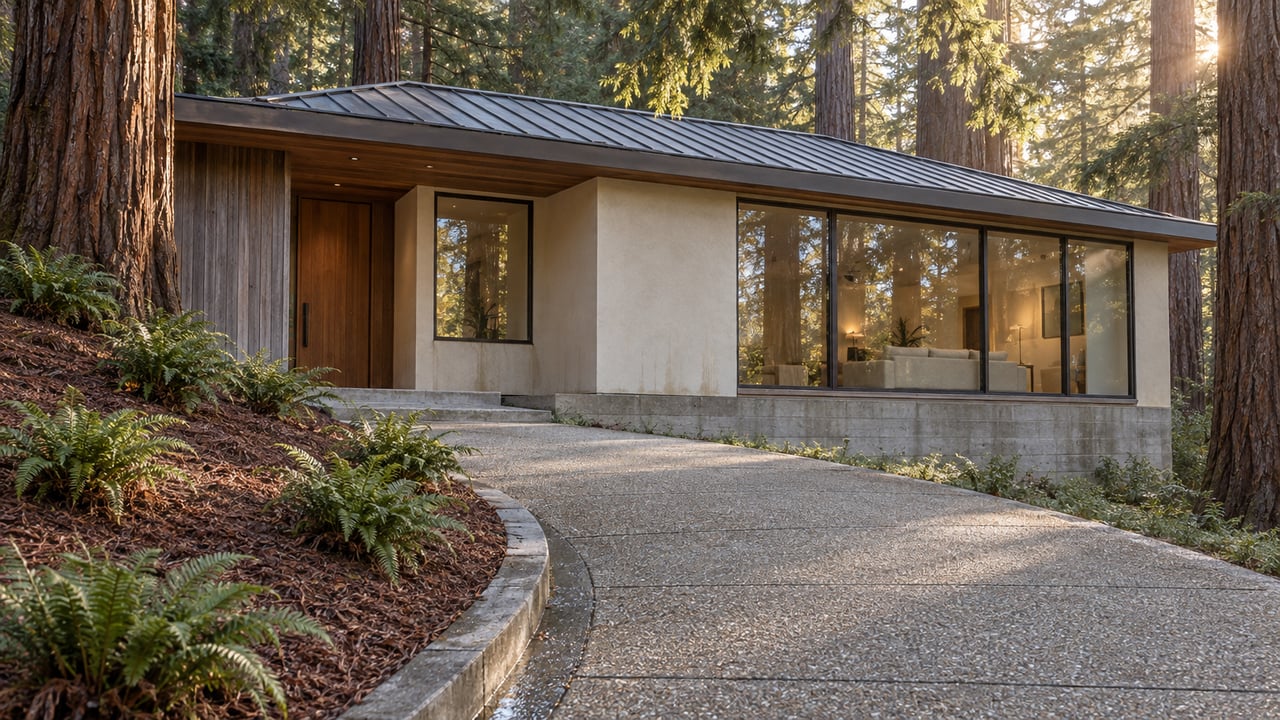
In 2009, 28 households in one Bonny Doon road association split a $50,000 bill to pave their private road. That December, one of their neighbors went to a Resource Conservation District workshop in Davenport. He told the Santa Cruz Sentinel the group was "just anxious to see what the El Nino is going to do to our improvements."
Seventeen years later, the same district has put up a 2026 El Niño Readiness page. It says forecasters predict this "could be a significant El Niño year" for Santa Cruz County. For anyone buying or selling a Bonny Doon home on a road the County doesn't maintain, that changes which questions come up in escrow. Buyers often ask first whether there's a signed road maintenance agreement. In California, that document usually matters less than they expect. The recorded right to use the road, and the road's condition when the appraiser drives in, usually matter more.
California Already Wrote the Default Agreement
The rule is in California Civil Code Section 845. It applies to private rights-of-way, which is the legal category most shared rural roads fall into:
"If the easement is owned by more than one person, or is attached to parcels of land under different ownership, the cost of maintaining it in repair shall be shared by each owner of the easement or the owners of the parcels of land, as the case may be, pursuant to the terms of any agreement entered into by the parties for that purpose. In the absence of an agreement, the cost shall be shared proportionately to the use made of the easement by each owner."
The statute also covers what happens when someone won't pay. After a written demand, the other owners can sue for that owner's share, together or one at a time. A small claim goes to small claims court. Larger claims go to superior court and judicial arbitration.
So a Bonny Doon road with no written agreement still has a cost-sharing rule. It's a vague one, since "proportionate to use" is open to argument, but it exists. That fact shapes how lenders treat these roads.
What Each Loan Program Actually Checks
Most buyers finance with one of three loan types. None of them requires a separate maintenance agreement for a California private road, and each one checks something else.
| Loan type | Maintenance agreement | What it does look for |
|---|---|---|
| Conventional, Fannie Mae | Required in general, but the Selling Guide says no separate agreement is needed in a state whose statutes define owners' maintenance duties | A recorded, enforceable agreement in states without such a statute |
| FHA | "Not required," per Handbook 4000.1 | A permanent recorded easement, ownership interest, or HOA ownership and maintenance, plus all-weather vehicle access |
| VA | Requirement removed in November 2022 | A recorded permanent easement or right-of-way to a public road in the loan file |
The current Fannie Mae Selling Guide, published October 7, 2026, says that if a property is in a state with "statutory provisions that define the responsibilities of property owners for the maintenance and repair of a private street, no separate agreement or covenant is required." Section 845 is that kind of provision. Your lender still makes the final call on any loan, but the guide's wording lines up with California law.
FHA puts its emphasis on the road itself. The HUD Handbook 4000.1 defines adequate vehicle access as an all-weather road that emergency vehicles and typical passenger cars can use. It tells the appraiser to report evidence of a permanent easement, ask whether a maintenance agreement exists, and comment on the road's condition. VA's Circular 26-22-17 dropped the agreement requirement but kept the recorded easement requirement.
FHA and VA both want proof that the owner has a legal right to reach the house, and FHA also wants a road a passenger car can drive.
"Public" and "County-Maintained" Describe Different Things
The next confusion is over who owns the road and who keeps it up. Santa Cruz County's Public Works explainer, "Is this a County maintained road?", puts it this way: "a County maintained road is a public right of way, but a public right of way may not be a County maintained road."
The County maintains about 595 miles of road, and a road joins that system only when the Board of Supervisors passes a resolution accepting it. Some roads are dedicated to public use but never accepted. For those, the County says "who is supposed to maintain it" may not be defined, and in practice the owners along the road usually organize the work. Public Works "does not maintain or arbitrate over the use of the roads that are not accepted." You can check a road's status on the County GIS map by turning on the "County Maintained Roads" layer, which the County Maintained Road System page describes.
Bonny Doon got a recent look at what County involvement means. At the Rural Bonny Doon Association's October 28 public meeting, Jeff de los Santos, a Senior Civil Engineer with County Public Works, was scheduled to present a proposal for the Pine Flat Road and Ice Cream Grade intersection near Bonny Doon Elementary. The plan is to remove trees to improve sight distance, and it came out of safety concerns raised by residents, according to the RBDA's October–December Highlander. On a road the County never accepted, the County has said it doesn't maintain or arbitrate, so a resident's concern goes to the neighbors who share the road.
Where the Repair Money Comes From
Some Bonny Doon homes on non-County roads pay for upkeep through a line on the property tax bill. The County runs 36 road County Service Areas, or CSAs. Each is funded by an annual benefit assessment that the County says generally runs $10 to $2,300 a year. The posted charge reports are preliminary 2025–26 figures based on proposed rates, and the County notes the official 2026–27 roll wasn't yet available. That makes the tax bill for a specific parcel the reliable source. CSA money has conditions too. Work needs prior County approval and enough funding, and the County's procurement rules apply.
Roads outside a CSA rely on neighbors chipping in, like the 28 households in 2009, or on outside help. The RCD's Rural Roads Program offers road associations, CSAs and individual owners on-site technical help with drainage and erosion, and possible cost-share for construction.
Bigger failures can cost far more. After a 2023 storm collapsed part of Harmon Gulch Road, a private road elsewhere in the county, neighbors raised about $180,000 through individual FEMA claims, crowdfunding and a nonprofit, Santa Cruz Local reported. That road isn't in Bonny Doon, but the cost shows how big a shared repair bill can get after a major storm.
Why This Winter Puts the Road Into Escrow
FHA asks the appraiser to comment on the road's condition. California's Transfer Disclosure Statement, in the sample published by the Department of Real Estate, asks the seller whether features shared with adjoining owners carry use or maintenance responsibilities, and whether easements affect the property.
If the RCD's forecast holds, a listing that comes up after the first big storms could have an appraisal and disclosures that reflect a washed-out culvert or a rutted grade. For sellers, knowing the road's repair history and who has paid for what makes those disclosure questions easier to answer. For buyers, the road becomes part of the inspection, even though no home inspector is hired to look at it.
What to Pull Before You Write or Accept an Offer
- County-maintained status. Check the road on the County GIS map's "County Maintained Roads" layer.
- The recorded access easement. The title report should show a recorded right-of-way from the property to a public road. This is the item FHA and VA require.
- Any recorded maintenance covenant. If one exists, it sets the cost shares in place of the "proportionate to use" default.
- A CSA line on the tax bill. Look up the parcel's current bill rather than a posted charge report.
- Repair history. Find out who organized past work, who paid, and whether the RCD has done any assessment.
A Few Quick Questions
Is a road with no written agreement a problem for a conventional loan? Fannie Mae's guide says no separate agreement is needed where state statute defines owners' maintenance duties, and Civil Code §845 does that in California. Your lender makes the final decision.
Can a neighbor be made to pay a share? Section 845 lets the other owners sue for an unpaid share after a written demand, in small claims court if the amount is within its limit.
Does "public road" mean the County plows and patches it? No. A public right of way the County never accepted is not County-maintained, and Public Works doesn't maintain or arbitrate those roads.
This post is general information, not legal, tax or financial advice. Please confirm the details for your own property with a real estate attorney, title officer or lender.
If you're thinking about selling a Bonny Doon home on a shared road, or you've found one you'd like to buy, Genie Lawless can help you gather the easement, tax bill and repair history before they come up in escrow. Start with a home valuation, and we'll go over the road at the same time.